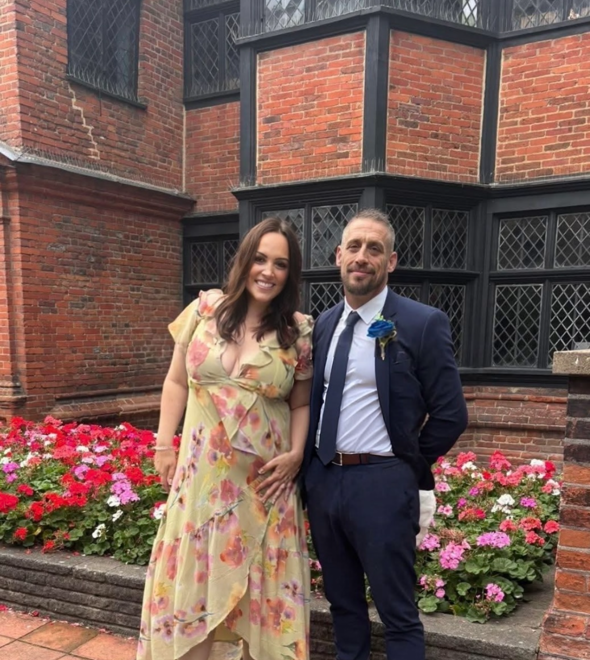


Steroids ruined my fertility: how Brett and Ali finally welcomed Polly after male factor infertility
29.10.2026
When Brett Cole and his wife Ali Clautour, both 43, from Chatham in Kent, first started trying for a baby in 2016, Brett assumed the path to expanding their family would be simple. He was already a father to a son from a previous relationship, was in good physical shape, involved in martial arts, and had never been seriously ill or needed any type of surgery.
But after years of trying, a devastating diagnosis of male factor infertility turned his world upside down, launching the couple into a decade-long battle involving surgery, IVF, heartbreak, and ultimately, an extraordinary miracle.
After 12 months of unsuccessful trying, like many couples, Brett and Ali initially assumed any potential fertility issues lay with the female partner. When NHS investigations in 2019 revealed that Brett had a zero sperm count (azoospermia), the reality set in. This was because of Brett taking steroids regularly at the martial arts gym he trained at. It was a normal thing there and accepted as the best way to train and get fit.
“When I realised I was the reason, it became so much harder,” reflects Brett, who works as a security guard. “I felt entirely responsible. When you know your poor choices have caused this and then you have to watch your partner suffer through procedures themselves, even though it’s not their fault, you still feel like you are the cause. That feeling stays with you.”
Because Brett already had a son from his previous relationship, the couple were not entitled to NHS-funded IVF treatment. Having to navigate male factor infertility privately was an isolating and overwhelming experience.
“Like most men, I thought I was invincible. I worked out regularly, but I also had a bad diet and drank at the weekends. I didn’t even know male infertility was a thing until it happened to me. A phrase I heard from the lads at the gym was about men ‘firing blanks.’ When I realised what was happening to me, I felt completely alone and disappointed in myself.”
The societal stigma surrounding male fertility left Brett with nowhere to turn. “It’s hard for men to talk at the best of times. You look at male mental health and suicide rates, men just don’t open up. People would say, ‘chin up, it’ll be alright,’ but there were no support groups and no one to talk to. Online forums weren’t for me either. I genuinely wondered at one point if I should leave Ali so she could find someone else and have a baby. I just wanted her to be happy, even if it wasn’t with me.”
“I found it hard to talk to anyone about what I was going through. Ali was the only person I ever spoke to – until now.”
Their initial clinical experiences only deepened his sense of alienation. At their first clinic, Brett was directed under a flight of stairs into a cupboard with a plastic chair to give a sample.
“I felt like a spare part. Secondary in the process and seedy, and just along for the ride,” he remembers. “The clinic made donor sperm sound like the only realistic option forward, but Ali was devastated and refused to accept that without exploring every option available to us.”
Determined not to give up, Ali researched male factor treatments online and someone on Instagram recommended Professor Minhas at London Andrology. Brett firstly had TESE (Testicular sperm aspiration), which is a non-surgical procedure when a fine needle is inserted through the skin into the testicle to suction fluid and tissue. When this didn’t work, he then underwent micro-TESE (microscopic testicular sperm extraction), a specialised surgical procedure designed to retrieve sperm directly from testicular tissue. The testicle is opened and an operating microscope is used to look deep into the tissue for tiny, hidden pockets of sperm.
For Brett, who has ADHD and finds hospital environments particularly daunting, undergoing surgery was frightening, but his devotion to Ali made it an easy choice. “What I went through was minor compared to what you watch your partner go through,” he says. “It wasn’t a question of whether to do it; it was about doing whatever it took.”
The micro-TESE procedure was a success, yielding four viable vials of frozen sperm. Brett remembers looking around the recovery room at another patient whose surgery had unfortunately failed. “I still think about him now and wonder how his life went after that news,” Brett says. “I knew right then how lucky I was.”
Once they had the sperm, the couple turned to the Centre for Reproductive and Genetic Health (CRGH) in London for IVF treatment, choosing fertility consultant Dr Niki Chronopoulou. From the moment they stepped into CRGH, the experience felt very different for Brett. The supportive atmosphere, tailored care, and warm reception from staff made them feel valued and supported throughout the IVF emotional rollercoaster.
Across two IVF cycles, five frozen blastocysts were created (one in the first cycle and four in the second). However, the journey was far from smooth. Their first double embryo transfer failed, coinciding with the heartbreaking death of Ali’s grandmother. A second transfer resulted in pregnancy, but early scans revealed no heartbeat, leading to a miscarriage.
“When we lost the pregnancy, I felt like I couldn’t do it again,” Brett admits. “The emotional pressure on a man, knowing everything relies on your retrieved sample and watching your wife go through loss, is overwhelming. I couldn’t do anything to help her.”
By early 2025, after spending £40,000 and reaching their final remaining vial of sperm, they were down to their last embryo. It was the single blastocyst created during their very first IVF cycle, the one that had initially left them disheartened due to only producing the one embryo.
Knowing this was their absolute final chance, Ali took a pregnancy test in a Tesco toilet eight days after the transfer – and it was positive. Nine months later, the couple finally welcomed their daughter, Polly.
“When I first saw her on the screen, and then holding her in my arms, I looked at Ali and knew every single second was worth it,” says Brett. “I don’t think I have ever loved anything like I love Polly. I prayed for her so much. Sometimes I sit here and wonder what I ever did to deserve her.”
Life at home in Kent is now very different. In an amazing twist of fate, Brett’s eldest son, who was 13 when Brett and Ali first met and is now serving in the Army, is currently expecting a child of his own, making Brett both a new father and a grandfather within months.
Looking back on his journey, Brett hopes sharing his story will break the silence around male factor infertility and encourage men to seek help, ask for second opinions if they don’t feel comfortable with the advice being given, and open up about their struggles. “If there is one thing I learnt from my experience, finding the support is the hardest part – I really do hope by talking it will help at least one person open up and know this is more common than people realise.”
Dr Elpiniki Chronopoulou (Dr Niki), fertility consultant, obstetrician and gynaecologist at CRGH said: “It is wonderful to see Ali and Brett welcome Polly into the world. One of the most important aspects of fertility treatment is ensuring that patients feel comfortable, supported and empowered to make informed decisions at every stage of their journey. It is a real privilege to guide Ali and Brett through these choices and to have played a part in their journey to parenthood.
“It is important to recognise that men’s experiences of fertility treatment deserves greater attention. Male fertility challenges can often be overlooked, potentially delaying diagnosis and access to appropriate support. Ensuring that men feel heard, supported and included is essential every step of the way. I am truly grateful to be part of their story and Polly’s.’